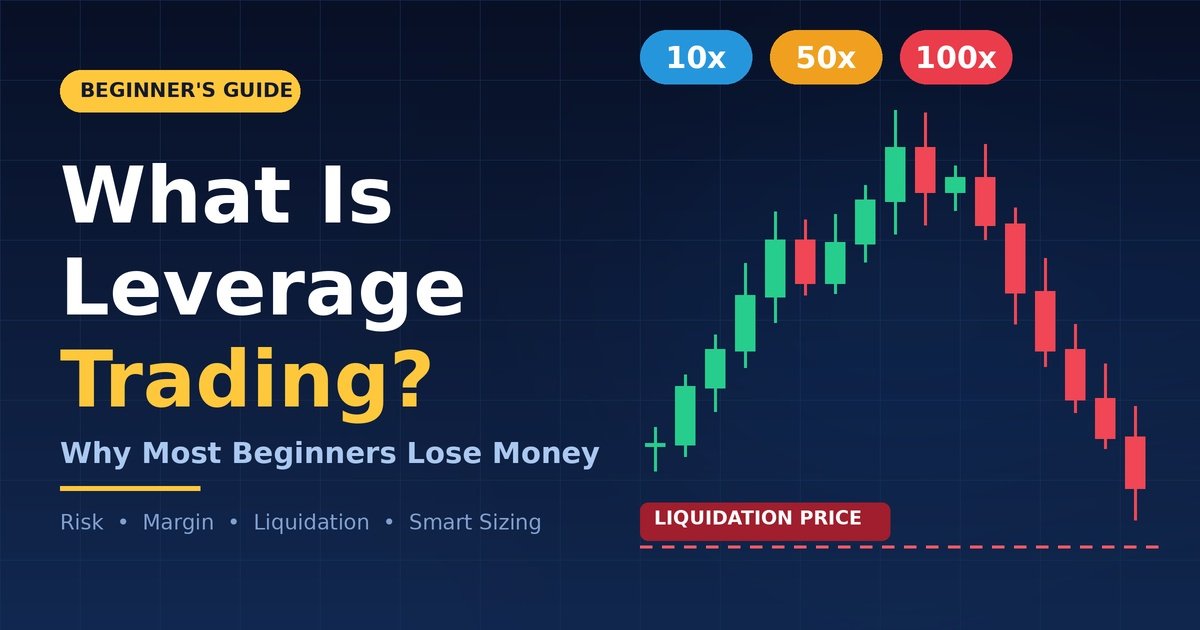
Almost every new trader sees the same ad sooner or later: “Turn $100 into $10,000 with 100x leverage!” It sounds like a shortcut to freedom. In reality, it is one of the fastest ways to empty a trading account.
I’m not saying leverage is evil. Used carefully, it is a legitimate tool. But if you don’t understand how it works, it magnifies your mistakes far more than your profits. This guide explains leverage trading in plain English, shows why traders lose money, and gives you a safer way to start.
What Is Leverage in Trading?
Leverage means trading with borrowed funds to control a larger position than your own money would allow. The exchange or broker lends you the extra amount, and your own money acts as security.
The leverage ratio shows the size of the boost. With 10x leverage, every $1 of yours controls $10 in the market.
Key Terms You Must Know
- Margin requirement: the amount of your own money you must lock up to open a leveraged trade.
- Position size: the total value of the trade, including borrowed funds.
- Liquidation price: the price at which your position is closed automatically because your margin can no longer cover the loss.
- Margin call: a warning (mostly in forex and stock brokers) that your balance is too low and you need to add funds.
How Leverage Trading Works (With a Real Example)
Let’s say you have $100 and use 10x leverage. You open a long position on Bitcoin worth $1,000.
- If Bitcoin rises 5%, your position gains $50. That is a 50% return on your $100.
- If Bitcoin falls 5%, you lose $50, or 50% of your money.
- If Bitcoin falls around 10%, your margin is gone and you get liquidated.
A short position works the opposite way. You profit when the price falls and lose when it rises. Both directions carry the same risk.
How Leverage Changes Your Liquidation Distance
Here is a simple, approximate guide (fees and maintenance margin make real numbers slightly tighter):
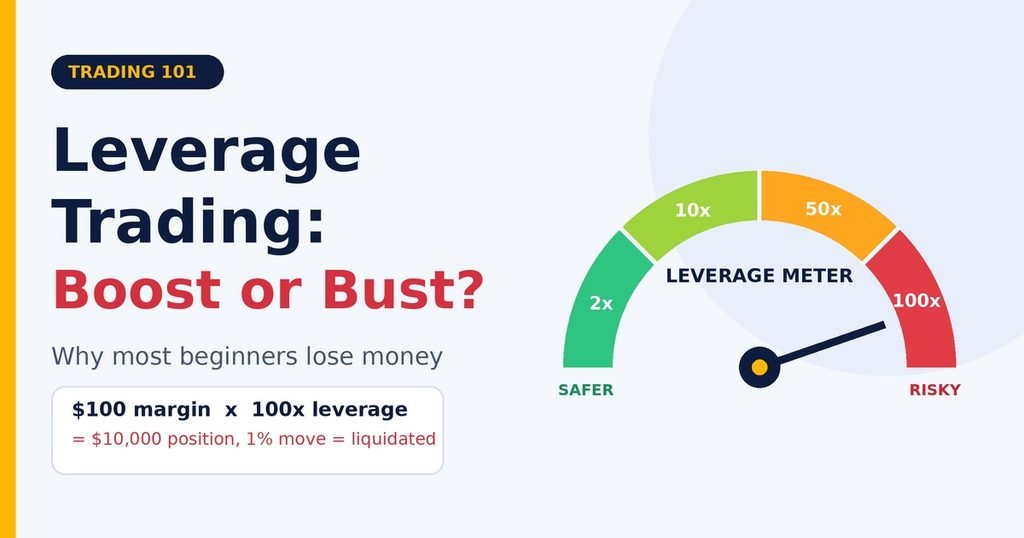
- 10x leverage: a price move of about 10% against you wipes out your margin.
- 50x leverage: about 2%.
- 100x leverage: about 1%.
Crypto can move 1% in a few minutes, so 100x leverage leaves almost no breathing room.
Margin Trading vs Leverage Trading
People use these terms interchangeably, and that causes confusion. Here is the simple difference:
- Margin is the money you put up as collateral.
- Leverage is the multiplier that margin gives you.
So when comparing margin trading vs leverage trading, you are really looking at two sides of one mechanism. Margin is the deposit, and leverage is the result.
Crypto vs Forex Leverage Trading
Crypto leverage trading usually happens on futures trading platforms. Leverage can reach 100x or more, and the market runs 24/7. High volatility makes it very risky.
Forex leverage trading is regulated in many countries. Limits like 30:1 or 50:1 exist in several regions to protect retail traders, and brokers may issue a margin call before closing your trades.
Spot Trading vs Leverage Trading
| Feature | Spot Trading | Leverage Trading |
|---|---|---|
| Capital needed | Full amount | Small margin |
| Borrowed funds | No | Yes |
| Maximum loss | Your investment (price can only go to zero) | Your entire margin, quickly |
| Liquidation risk | None | High |
| Profit potential | Moderate | Magnified |
| Stress level | Lower | Much higher |
| Best for | Beginners | Experienced traders |
Why Most Beginners Lose Money
If you have wondered why traders lose money, the answer is rarely “bad luck.” It usually comes down to a handful of repeating mistakes.
1. Using Too Much Leverage
Beginners pick 50x or 100x because the potential profit looks exciting. A tiny dip then liquidates them before the trade has any chance to work.
2. Ignoring Risk Management in Trading
No plan, no stop loss and take profit levels, and no maximum loss per trade. Professionals decide how much they can lose before they enter. Beginners decide after they are already losing.
3. Oversized Position Size
Putting your whole balance into one trade is gambling. Even a good idea fails sometimes, and one bad trade shouldn’t end your account.
4. Overtrading
After a loss, many beginners open trade after trade to “win it back.” Fees pile up, decisions get sloppy, and small losses become big ones.
5. Weak Trading Psychology
Emotional trading is the silent account killer. Fear makes you close winners too early. Greed makes you hold losers too long. Revenge trading makes you break your own rules.
6. Underestimating Volatility
Sudden news, big liquidations, and sharp wicks can push price through your stop loss. If you haven’t studied how a market behaves, leverage turns normal swings into disasters.
Leverage Trading Risks: Pros and Cons
Pros
- Control a bigger position with less capital
- Ability to profit in falling markets through short positions
- Capital stays free for other uses
- Useful for hedging in experienced hands
Cons
- Losses are magnified as much as profits
- Fast liquidation can wipe out your margin
- Funding fees and interest add up over time
- High emotional pressure
- A steep learning curve with little room for error
Is Leverage Trading Profitable?
It can be, but not for most people. Regulatory disclosures from many brokers show that a large majority of retail leveraged accounts lose money, often well over half. Profit comes from discipline, small leverage, and consistent risk control, not from big bets.
Treat any promise of “guaranteed returns” as a red flag.
Leverage Trading for Beginners: A Safer Step-by-Step Approach
- Learn first. Understand margin, liquidation, and funding rates before you deposit anything.
- Practice on a demo account for at least a few weeks.
- Start with 2x to 3x leverage. Higher numbers can wait until you have a track record.
- Risk only 1% to 2% of your account per trade.
- Always set a stop loss and know your take profit before entering.
- Use isolated margin so one bad trade can’t touch your whole balance.
- Keep a trading journal. Write down why you entered and how you felt. Patterns show up quickly.
- Only use money you can afford to lose.
A Quick Example of Smart Sizing
With a $1,000 account, risking 1% means you accept a maximum loss of $10 on a trade. If your stop loss is 2% away from your entry, your position size should be about $500. That is the logic professionals use, and it works at any account size.
A Quick Note on Finding Trustworthy Trading Info in 2026
Search has changed. AI Overviews and zero-click results now answer many questions without sending anyone to a website, and AI search engines favor content that shows real experience, expertise, authoritativeness, and trust (E-E-A-T). Because of that, human-written content from people who have actually traded matters more than ever.
When you research leverage, look for:
- Authors who share real experience, including losses
- Clear risk warnings, not hype
- Easy-to-read pages with a clean user experience
- Sources you can verify
If a page promises easy money, close it.
Frequently Asked Questions
1. What is leverage trading in simple words?
It is trading with borrowed money so you can control a bigger position than your own balance allows.
2. Is leverage trading good for beginners?
Usually not at high levels. If you try it, use very low leverage and a demo account first.
3. What is a liquidation price?
It is the price at which your exchange closes your trade because your margin can no longer cover the loss.
4. What is the difference between a margin call and liquidation?
A margin call is a warning to add funds. Liquidation is the forced closing of your trade. Many crypto platforms skip the warning and go straight to liquidation.
5. What leverage should a beginner use?
Most educators suggest 2x to 5x at the most, and many suggest starting with none.
6. Can I lose more than I invest?
In many crypto platforms with isolated margin, you lose only your margin. With some brokers and cross margin, losses can go beyond your deposit. Check the rules of your platform.
7. Is 100x leverage safe?
No. A 1% move against you can liquidate the trade, so it is extremely risky.
8. How do stop loss and take profit help?
A stop loss limits your loss, and a take profit locks in gains. Together they take emotion out of the trade.
9. What is the difference between futures trading and spot trading?
Spot means you buy the actual asset. Futures means you trade a contract on its price, often with leverage.
10. Is leverage trading profitable long term?
Only for a small group who manage risk strictly. Most beginners lose money, so treat it as a skill to build, not a quick-income tool.