
Most people hold crypto and wait for the price to go up. But what if your coins could earn something while they sit in your wallet? That’s the idea behind crypto staking for beginners: put your coins to work and get rewarded for helping a blockchain run.
If terms like “validators” and “APY” sound intimidating, relax. This guide explains everything in plain English, with practical steps and honest warnings.
This article is for education only and is not financial advice. Crypto is volatile, so never stake money you can’t afford to lose.
What Is Crypto Staking?
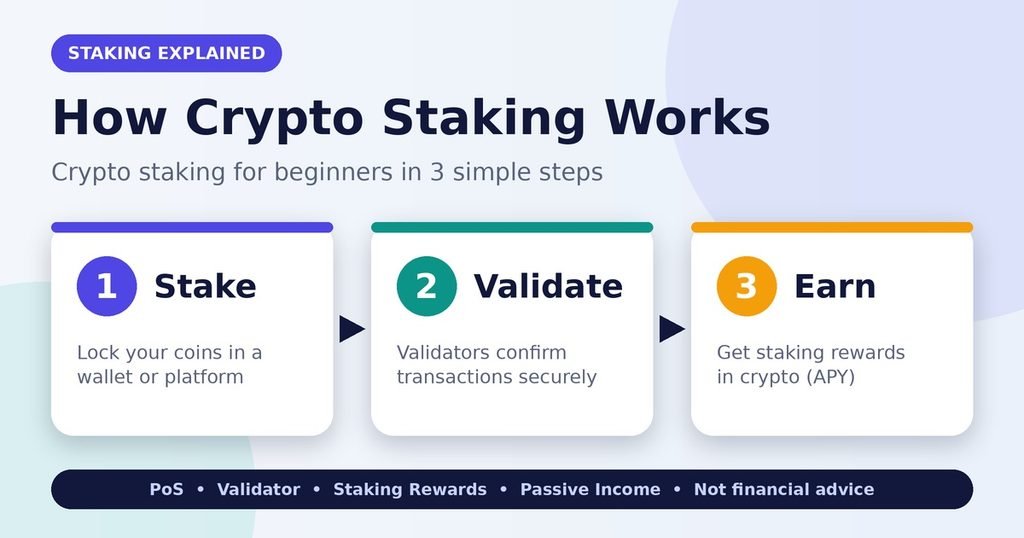
If you’re asking “what is crypto staking?”, here’s the short answer: you lock up some of your coins to help secure a blockchain network, and in return the network pays you rewards. Think of it like a savings account, except you’re helping run the bank instead of just depositing money. It’s one of the most popular ways to earn interest on crypto and build passive income crypto streams.
How Does Crypto Staking Work?
Staking works on blockchains that use proof of stake (PoS), a blockchain consensus mechanism that decides who gets to confirm transactions.
Here’s the simple version:
- The network needs people to verify transactions.
- Those people (validators) put up coins as a deposit.
- The network picks validators to confirm new blocks.
- Honest validators earn staking rewards. Dishonest or careless ones can face a slashing penalty, which means losing part of their stake.
Staking vs Mining
Bitcoin-style mining (proof of work) uses powerful computers and lots of electricity to solve puzzles. Staking replaces that with locked coins as the “proof” of commitment. When comparing staking vs mining, staking needs no special hardware and uses far less energy, which is why most newer networks, and Ethereum since 2022, use PoS.
Key Staking Terms Every Beginner Should Know
- Validator node: A computer that verifies transactions and proposes new blocks.
- Delegated staking: You assign your coins to a validator without running one yourself.
- Staking pool: A group of people combining funds to stake together.
- Lock-up period: The time your coins stay locked after you stake them.
- Unstaking period: The waiting time between requesting to withdraw and actually getting your coins back.
- Staking wallet: A wallet that supports staking, such as a hardware or software wallet.
- APY (annual percentage yield): The estimated yearly return, including compounding.
Types of Crypto Staking
Solo Staking (Running a Validator Node)
You run your own validator. This gives you full control but requires technical skill, hardware, and often a large deposit. Ethereum solo staking, for example, requires 32 ETH.
Delegated Staking and Staking Pools
You pick a validator or join a pool and share the rewards, minus a small fee. This is the easiest route for most newcomers.
Liquid Staking
You stake your coins and receive a token representing them, which you can use elsewhere in DeFi. It’s flexible, but it adds smart contract risk.
Cold Staking
Your coins stay in an offline wallet while still earning rewards, which is great for security-minded users. Support depends on the coin.
Exchange Staking (Binance, Coinbase)
Platforms like Binance and Coinbase handle everything with a few clicks. It’s very convenient, but you’re trusting a company with your assets.
Comparison: Which Staking Method Fits You?
| Method | Difficulty | Control | Typical Risk | Best For |
|---|---|---|---|---|
| Solo staking | High | Full | Slashing, technical errors | Advanced users |
| Delegated staking | Medium | High | Validator performance | Intermediate users |
| Liquid staking | Medium | Medium | Smart contract risk | DeFi-savvy users |
| Cold staking | Medium | Very high | Setup mistakes | Security-focused holders |
| Exchange staking | Very low | Low | Platform risk | Total beginners |
Best Crypto to Stake for Beginners
There’s no single “best crypto to stake,” because the right choice depends on your goals and risk tolerance. These three are popular starting points:
Ethereum Staking
Ethereum is the biggest PoS network. You can stake directly with 32 ETH, or use pools, liquid staking, or exchanges for smaller amounts. Rewards are usually modest but come from a well-established network.
Cardano Staking
Cardano uses delegation, and your coins never leave your wallet. It has no lock-up period in the traditional sense, so you can move your funds when you wish. That makes it popular with newcomers.
Solana Staking
Solana is known for speed and low fees. You delegate to a validator, and unstaking typically takes a few days, since funds become available after the current epoch ends.
Always check a coin’s current rules on its official website, because staking terms change over time.
Understanding Staking Rewards and APY
Crypto staking rewards vary by network, validator, and market conditions. Advertised APYs range from a few percent to well into double digits, but higher numbers usually signal higher risk.
A simple example: if you stake $1,000 at a 4% APY, you’d earn about $40 over a year, paid in the coin itself. If the coin’s price drops 30%, that reward won’t cover your loss. Rewards are paid in crypto, so your real return depends on price movement too.
How to Stake Crypto: Step-by-Step
- Choose a coin. Start with an established PoS network.
- Pick a platform. Compare staking platforms by fees, reputation, and security record.
- Set up a staking wallet or create an exchange account with two-factor authentication.
- Buy or transfer your coins. Start small.
- Select a validator or pool with a solid track record and reasonable fees.
- Check the terms. Note the lock-up period, unstaking period, and fees.
- Stake and monitor. Review your rewards occasionally, but don’t obsess over daily changes.
Is Crypto Staking Safe?
It’s safer than many crypto strategies, but it’s not risk-free. Here’s what to watch:
- Price risk: Your coins can lose value while locked.
- Slashing penalty: Validator misbehavior or downtime can cost you on some networks.
- Lock-up and unstaking periods: You may be unable to sell quickly in a crash.
- Platform risk: Exchanges and protocols can be hacked or fail.
- Smart contract bugs: Especially relevant for liquid staking.
Pros and Cons of Crypto Staking
Pros
- Earn rewards without trading
- Lower energy use than mining
- Beginner-friendly options exist
- Helps secure the networks you believe in
Cons
- Funds can be locked
- Rewards aren’t guaranteed
- Technical and platform risks
- Taxes may apply to rewards in your country
Practical Tips for Beginners
- Start with a small amount while you learn.
- Diversify rather than staking everything in one coin.
- Avoid “guaranteed” high-yield offers, which are a classic scam sign.
- Use hardware wallets for larger holdings.
- Keep records of your rewards for tax purposes.
Researching Staking in the Age of AI Search
In 2026, many people get quick answers from AI Overviews and chatbots without ever clicking a link. That’s convenient, but crypto details change fast, so an AI summary can be outdated. Always verify APYs, fees, and rules on the official network or platform website. Look for content written by real people who show experience and cite sources, because trustworthy, human-written information matters most when your money is involved.
Frequently Asked Questions
1. Can beginners really stake crypto?
Yes. Exchange staking and delegation make it easy, with no technical skills needed.
2. How much money do I need to start?
It depends on the platform. Many exchanges and pools allow very small amounts, while solo Ethereum staking requires 32 ETH.
3. Are staking rewards guaranteed?
No. Rates change with network activity and participation.
4. What’s the difference between staking and holding?
Holding just keeps coins idle. Staking puts them to work to earn rewards.
5. Can I lose money staking?
Yes, through price drops, slashing, or platform failures.
6. How long does unstaking take?
It ranges from instant or a few days to longer, depending on the network and demand.
7. Is staking taxable?
In many countries, rewards count as income. Check your local rules or consult a tax professional.
8. Is exchange staking better than a wallet?
Exchanges are easier, while wallets give you more control. Pick based on your comfort level.
9. What is liquid staking best for?
It suits users who want rewards while keeping their funds usable in DeFi.
10. Should I stake all my crypto?
No. Keep some liquid for emergencies and opportunities.