
If you have ever opened a crypto app and wondered why everyone keeps arguing about bitcoin vs ethereum, you are not alone. Both are famous, both are worth billions, and both get called “the future of money.” Yet they were built for very different jobs.
I have spent years explaining crypto to friends, family and readers who were starting from zero, and the same question comes up every time: “Which one should I care about?” This guide gives you a clear, honest answer in plain English. No hype, no jargon walls, just what you need to understand the difference between bitcoin and ethereum and decide your next step.
Quick answer: Bitcoin is mainly digital gold, a store of value. Ethereum is a programmable platform for apps and smart contracts. Neither is “better” in every way; they solve different problems.
What Is Bitcoin?
If you are asking “what is bitcoin,” think of it as the first digital currency that works without a bank or government in charge. It launched in 2009, created by a person or group using the name Satoshi Nakamoto.
Bitcoin runs on blockchain technology, a shared public record book that thousands of computers keep in sync. Once a transaction is written there, it is extremely hard to change.
Key facts about Bitcoin:
- Only 21 million bitcoins can ever exist.
- New coins are created through mining, which uses computing power (called proof of work).
- Its supply shrinks over time through events called halvings.
- Many people call it digital gold and treat it as a store of value.
What Is Ethereum?
Now the second question: what is ethereum? Launched in 2015 by Vitalik Buterin and co-founders, Ethereum is a decentralized network that does more than move money. It lets developers build programs called smart contracts, which run automatically when conditions are met.
That is why Ethereum powers things like decentralized finance (DeFi), NFTs and thousands of decentralized apps. Its native coin is called ether (ETH), and you use it to pay “gas fees” for activity on the network.
In 2022, Ethereum switched from mining to proof of stake, where people lock up ETH to help secure the network. This cut its energy use dramatically.
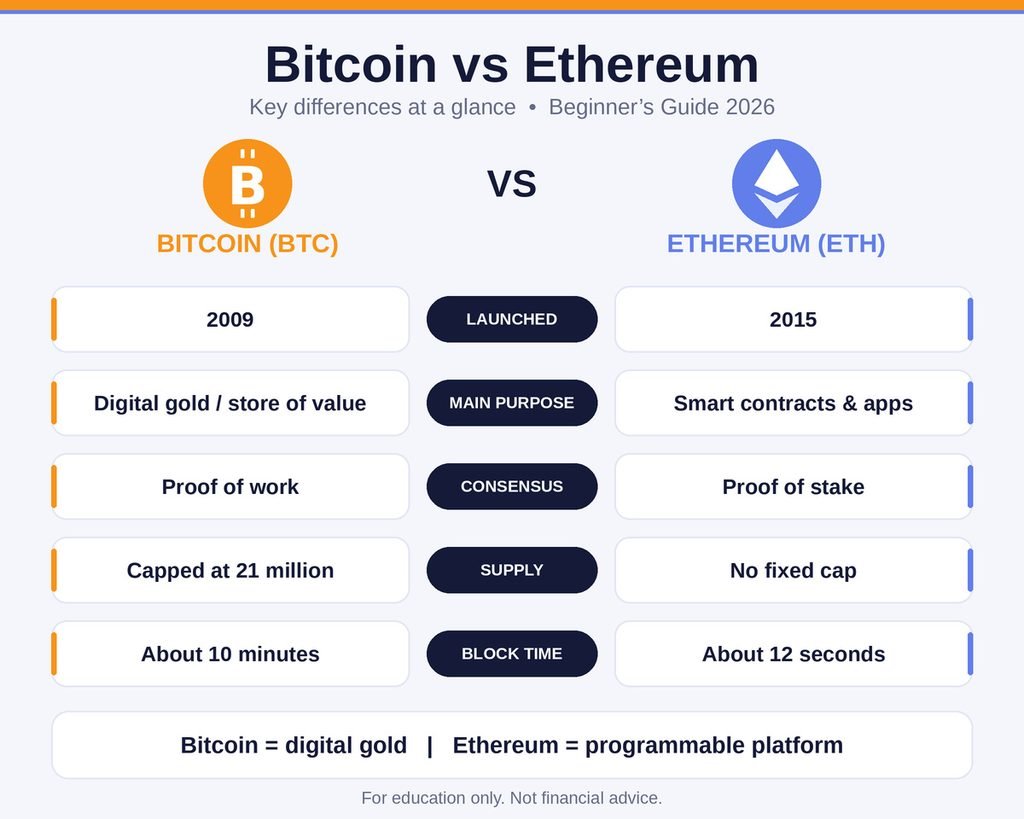
Bitcoin vs Ethereum Comparison Table
| Feature | Bitcoin (BTC) | Ethereum (ETH) |
|---|---|---|
| Launched | 2009 | 2015 |
| Main purpose | Digital gold, store of value | Platform for smart contracts and apps |
| Consensus method | Proof of work | Proof of stake |
| Supply | Capped at 21 million | No fixed cap |
| Block time | About 10 minutes | About 12 seconds |
| Typical use | Saving, long-term holding | DeFi, NFTs, apps, payments |
| Risk profile | Volatile, but more established | More volatile, more tied to tech adoption |
The Difference Between Bitcoin and Ethereum, Explained
1. Purpose
Bitcoin does one thing and tries to do it well: be secure, scarce money. Ethereum is more like a global computer that anyone can build on. Comparing them is a bit like comparing gold bars to an app store. Both have value, but for different reasons.
2. Bitcoin vs Ethereum Technology
Bitcoin keeps its code simple on purpose. Changes are rare and slow, which many fans see as a strength. Ethereum updates more often and supports complex programs, which gives it flexibility but also more moving parts.
3. Supply and Scarcity
Bitcoin’s hard cap is the heart of its “digital gold” story. Ethereum has no hard cap, though upgrades have reduced how fast new ETH enters circulation. Scarcity matters because it shapes how people think about long-term value.
4. Speed and Fees
Ethereum confirms blocks much faster, but busy periods can still push gas fees up. Bitcoin is slower on its base layer, so extra tools like the Lightning Network are often used for quick, cheap payments.
Bitcoin vs Ethereum Price: Why ETH Looks “Cheaper”
Beginners often see that one BTC costs far more than one ETH and assume ETH is the bargain. That is a trap. A coin’s price alone tells you nothing. What matters is market cap (price multiplied by the number of coins in circulation) and what you believe about future demand.
Prices change every minute, so always check a live source like CoinMarketCap or CoinGecko rather than trusting an old article, including this one. You can also buy a small fraction of either coin, so a high price is not a barrier.
Bitcoin vs Ethereum Investment: Pros and Cons
This is the section most readers jump to, so let’s be fair to both sides.
Bitcoin Pros and Cons
Pros:
- Longest track record in crypto
- Strong brand and wide acceptance
- Simple, easy-to-explain story
- Fixed supply
Cons:
- Limited use beyond holding and sending value
- Slower base-layer transactions
- Still very volatile
Ethereum Pros and Cons
Pros:
- Huge ecosystem of apps, developers and tools
- Earns staking rewards for holders who stake
- Lower energy use than mining
- More room to grow if blockchain apps expand
Cons:
- More competition from other smart contract networks
- Technical complexity
- Gas fees during busy times
- Even bigger price swings in some periods
Bitcoin or Ethereum: Which Is Better for Beginners?
So, is bitcoin or ethereum a better investment? Honestly, nobody can promise that, and anyone who does is selling something. Here is how I explain it to newcomers:
- Pick Bitcoin if you like simplicity and the “digital gold” idea.
- Pick Ethereum if you are curious about apps, DeFi and building on blockchain technology.
- Many beginners hold a small amount of both to spread risk.
This is the heart of bitcoin vs ethereum for beginners: understand what you are buying before you worry about which one wins.
How to Get Started: 6 Beginner Steps
If you are exploring cryptocurrency for beginners, follow this simple path:
- Learn first. Read and watch before you spend. Understanding comes before profit.
- Choose a regulated exchange available in your country with a good safety record.
- Set up security. Use a strong, unique password and two-factor authentication.
- Start small. Begin with an amount you could lose without stress.
- Consider a wallet. For larger holdings, a hardware wallet keeps your coins offline.
- Make a plan. Decide in advance whether you are holding long term or not, and avoid panic decisions.
Practical Tips From Experience
- Never invest money you need for rent, bills or emergencies.
- Beware of “guaranteed returns.” They are almost always scams.
- Avoid chasing hype. Buying because a coin is trending on social media is how many beginners get hurt.
- Keep records. Many countries tax crypto, so save your transaction history.
- Never share your seed phrase with anyone, ever.
How to Research Crypto Safely in 2026
Search has changed. AI Overviews and chatbots now summarize answers before you ever click a link, and many searches end without a single click. That is convenient, but summaries can be outdated or wrong, especially on fast-moving topics like crypto.
Here is how to protect yourself:
- Check who wrote the article. Real experience and expertise (what search engines call E-E-A-T) matter far more than polished but anonymous text.
- Verify prices and news on at least two trusted sources.
- Prefer human-written, transparent guides that explain their reasoning.
- Treat any AI summary as a starting point, not financial advice.
Frequently Asked Questions
1. What is the main difference between bitcoin and ethereum? Bitcoin is designed as digital money and a store of value. Ethereum is a platform for smart contracts and decentralized apps.
2. Which is better for beginners, bitcoin or ethereum? Bitcoin is simpler to understand. Ethereum offers more to explore. Many beginners start with a small amount of each.
3. Why is ethereum cheaper than bitcoin? A lower price per coin does not mean lower value. Total market cap is what counts.
4. Is ethereum faster than bitcoin? Yes, Ethereum blocks are confirmed much faster, though fees can rise when the network is busy.
5. Can ethereum overtake bitcoin? It is possible in theory, but no one can predict it. Both could also grow side by side.
6. Is bitcoin or ethereum a better investment? There is no guaranteed answer. Both are high risk, so research carefully and invest only what you can afford to lose.
7. Is ethereum safer than bitcoin? Both networks are secure at the protocol level. Most losses come from scams, weak passwords and exchange mistakes, not from the networks themselves.
8. Do I need to buy a whole bitcoin or ether? No. You can buy small fractions for a few dollars.
9. What is digital gold? It is a nickname for Bitcoin, based on its limited supply and its use as a store of value.
10. Is cryptocurrency legal? Rules differ by country. Check your local laws and use regulated platforms.