A friend of mine once showed me a screenshot of his “portfolio.” A token he bought for $200 was now worth $2,400 in just nine days. He was thrilled. Two weeks later he couldn’t sell a single coin, and the project’s Telegram group had vanished.
Stories like this are painfully common. This guide gives you the crypto scam red flags I wish he had known, so you can learn how to spot a crypto scam before your money is gone. Whether you’re a total beginner or already hold some coins, a few simple habits can protect you.
Why Crypto Scams Are Everywhere in 2026
Crypto moves fast, and rules differ from country to country. Scammers also use AI now to write polished websites, clone voices, and create fake “support agents” that sound completely real. A scam that looks professional is no longer rare.
If you search for answers online, you’ll often see a quick AI Overview at the top of the page. These summaries are handy for basics, but they can’t judge a specific project for you. Treat them as a starting point, then verify with real sources, because that is where experience beats automation.
Quick answer: A crypto project is likely a scam if it promises guaranteed profits, hides its team, pressures you to act fast, or won’t let you withdraw your money.
Common Crypto Scams to Avoid
Knowing the common crypto scams makes them much easier to recognize.
Rug Pull
Developers launch a token, hype it up, collect investor money, then drain the liquidity and disappear. The 2021 “Squid Game” token is a famous case: its price exploded, buyers found they couldn’t sell, and the creators walked away with millions.
Pump and Dump Scheme
A group buys a cheap coin, spreads hype on social media, and sells once newcomers pile in. The price crashes and late buyers take the loss.
Ponzi Scheme Crypto
Early investors are paid with money from newer investors. Bitconnect and OneCoin both followed this pattern, and both collapsed, costing victims billions combined.
Phishing Attacks Crypto
You get an email, DM, or text with a link to a “wallet verification” page. You enter your seed phrase, and your funds disappear within minutes.
Fake Crypto Exchange
These sites look like real trading platforms. You can deposit, but withdrawals are blocked unless you pay a “tax” or “unlock fee.”
Pig Butchering Scam
A stranger builds a friendship or romance over weeks, then “teaches” you to invest on a fake platform. The app shows big gains until you try to cash out.
Crypto Giveaway Scam
“Send 0.1 BTC and get 0.2 BTC back.” Real people never double your crypto. These often use hacked accounts or deepfake videos.
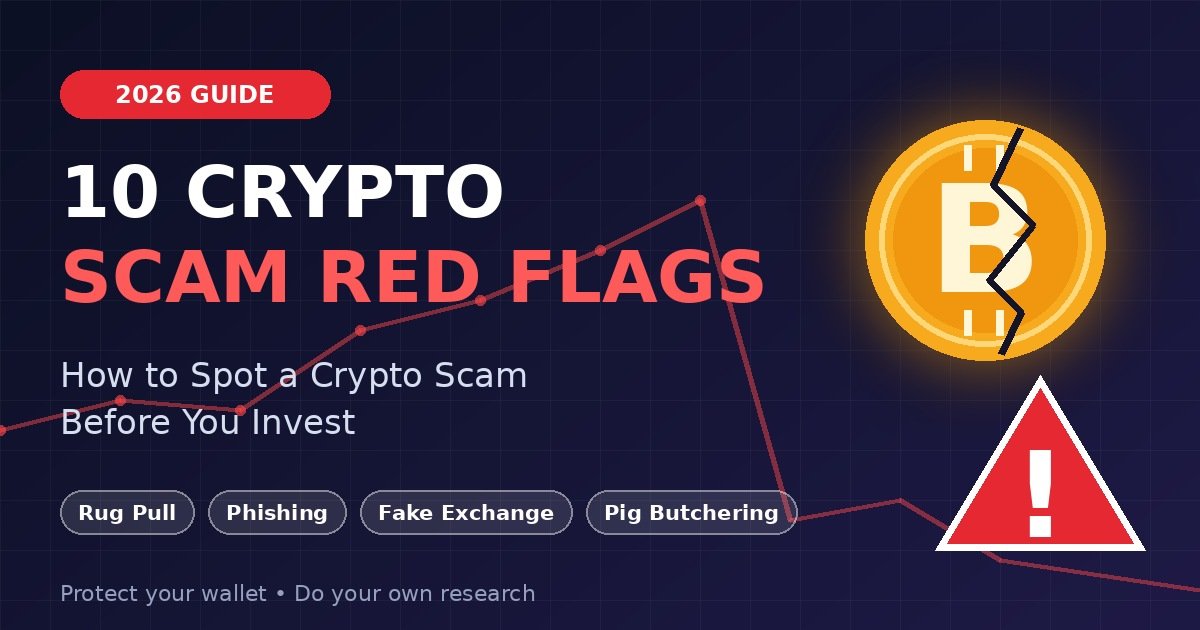
10 Crypto Scam Red Flags (Your Warning Signs)
Here are the signs of a crypto scam worth memorizing:
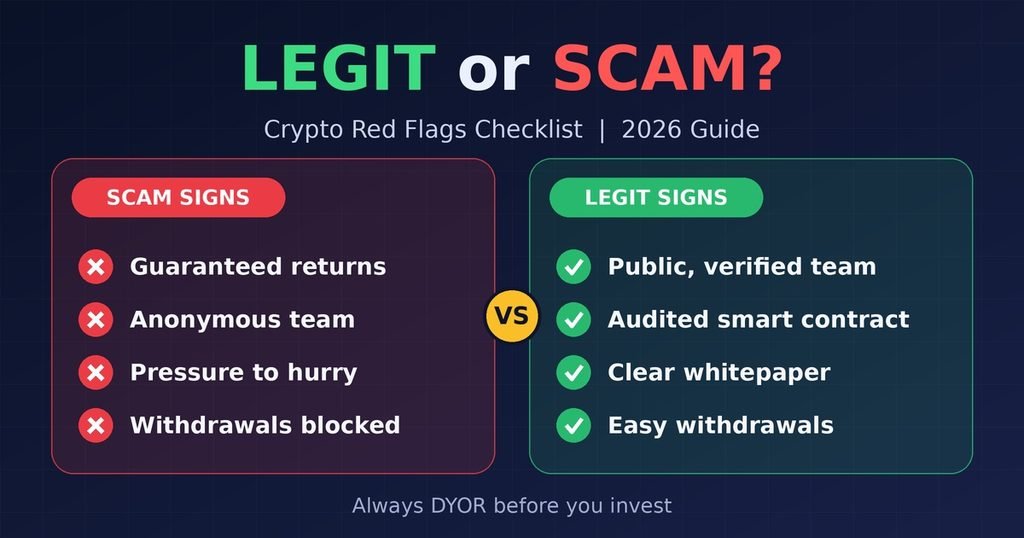
- Guaranteed returns. Real investments carry risk. Anyone promising fixed or “risk-free” profit is lying.
- Anonymous team crypto projects. If you can’t verify who runs it, nobody can be held accountable.
- Pressure to hurry. “Only 2 hours left to join!” is a classic trick.
- Celebrity crypto endorsement scam tactics. Stars are paid to promote, or their faces are faked. In 2022 the U.S. SEC fined Kim Kardashian for promoting a token without disclosing she was paid.
- Whitepaper red flags. Copied text, vague technology claims, no roadmap, and grammar errors suggest a rushed or fake project.
- Unaudited smart contract. No third-party security audit means hidden code could let developers steal funds.
- Fake ICO or token presale offers. Unsolicited presale invitations, especially through DMs, are almost always traps.
- Withdrawal problems. If you can’t take money out easily, stop depositing.
- Referral-heavy rewards. If earnings depend mostly on recruiting others, it’s likely a pyramid.
- Unsolicited contact. Strangers offering investment tips on WhatsApp, Instagram, or dating apps are a major warning.
These also double as cryptocurrency scam warning signs for new tokens, apps, and exchanges alike.
Legit vs Scam: A Quick Comparison
| Feature | Legit Project | Likely Scam |
|---|---|---|
| Team | Public, verifiable profiles | Anonymous or fake photos |
| Returns | Admits risk, no promises | “Guaranteed” or “risk-free” profit |
| Code | Audited by known security firms | No audit or fake audit |
| Withdrawals | Smooth and clear | Delays, extra fees, blocked |
| Marketing | Educational, transparent | Hype, urgency, influencers |
| Liquidity | Locked and verifiable | Unlocked, easy to drain |
| Support | Official channels | Random DMs, impersonators |
Crypto Scam Checklist: A Beginner-Friendly Process
Before putting money anywhere, run through this crypto scam checklist. It’s also a practical way to answer “is this crypto legit?”
- Search the name plus “scam” or “reviews.” Check Reddit, Trustpilot, and regulator warning lists.
- Verify the team. Look for real LinkedIn profiles, past work, and interviews.
- Read the whitepaper. Does it explain what the project actually does?
- Check the audit. Look for reports from reputable firms and confirm them on the firm’s own website.
- Look at the token on a blockchain explorer. A few wallets holding most of the supply is dangerous.
- Test withdrawals with a small amount first.
- Confirm the URL. Fake exchanges copy real sites with tiny spelling changes.
- Never invest money you can’t afford to lose.
DYOR: Do Your Own Research (The Right Way)
DYOR isn’t just watching YouTube videos. It means checking primary sources: official documentation, on-chain data, and regulator databases. A tip for 2026: when AI summaries or search snippets give you an answer, click through and confirm the details. Pages written by real people who tested things themselves tend to be far more reliable than generic summaries.
Crypto Wallet Security Basics
Strong crypto wallet security is one of the best forms of crypto fraud prevention:
- Never share your seed phrase. No legitimate support agent will ever ask for it.
- Use a hardware wallet for larger amounts.
- Enable two-factor authentication with an authenticator app, not SMS.
- Bookmark official sites instead of clicking links.
- Use a separate wallet for trying new projects, so your main funds stay safe.
- Review token approvals regularly and revoke ones you don’t need.
Real-World Examples Worth Remembering
- Squid Game token (2021): classic rug pull. Buyers couldn’t sell.
- Bitconnect (2018): promised huge monthly returns, then shut down.
- OneCoin: marketed as the next Bitcoin, but had no real blockchain.
- Pig butchering cases: victims often lose life savings after weeks of “friendly” chat.
The pattern is always the same: big promises, emotional pressure, and no way to verify anything.
Pros and Cons of Using a Crypto Scam Checklist
Pros
- Slows you down, which breaks scammers’ urgency tactics
- Helps beginners make decisions based on facts
- Works for tokens, exchanges, apps, and NFTs
- Costs nothing
Cons
- Takes time and effort
- Won’t catch every sophisticated scam
- Even legitimate projects can fail or lose value
- Requires a bit of technical comfort
A checklist reduces risk, but it never removes it.
Frequently Asked Questions
1. What are the first signs of a crypto scam?
Guaranteed returns, urgency, anonymous founders, and unsolicited messages are the most common early warnings.
2. How do I know if a crypto exchange is fake?
Check for regulatory registration, read independent reviews, and test a small withdrawal. Fake exchanges block cash-outs.
3. What is a rug pull?
It’s when developers drain investor funds from a project and abandon it, usually after a hype-driven price spike.
4. Are all anonymous crypto teams scams?
No. Bitcoin’s creator is anonymous. But for new projects asking for your money, an unverifiable team is a serious risk.
5. Can I get my money back after a scam?
Rarely. Report it quickly to your bank, exchange, and local cybercrime authority. Beware “recovery services,” which are often second scams.
6. What is a pig butchering scam?
A long con where scammers build trust, then push you into fake investments. The name comes from “fattening” the victim before the loss.
7. Is a celebrity endorsement proof a coin is safe?
No. Many endorsements are paid, and some are deepfakes. Always verify the project yourself.
8. Does an audit guarantee safety?
No, but a missing audit is a red flag. Always confirm the audit report on the auditor’s official site.
9. How does phishing steal crypto?
Fake links trick you into entering your seed phrase or approving a malicious transaction, giving scammers full wallet access.
10. Is DYOR enough to stay safe?
It helps a lot, but combine it with strong wallet habits and only invest what you can afford to lose.